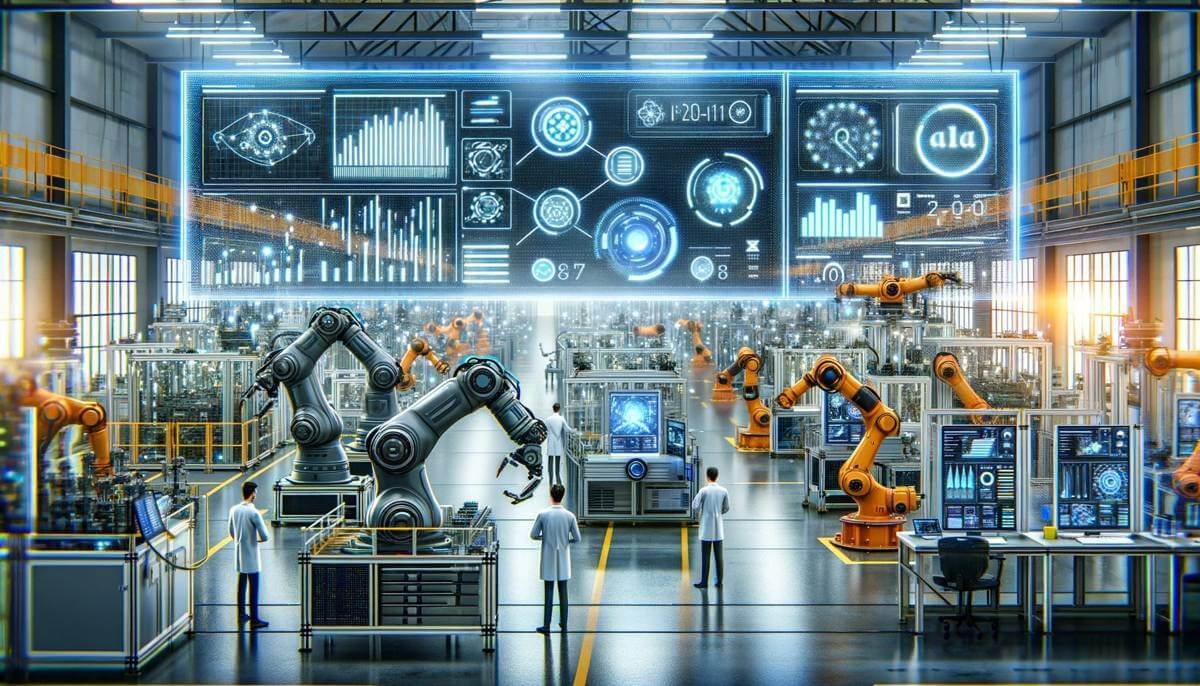

Artificial intelligence augments industrial robots by enabling decision-making beyond fixed programs. Perception and sensing convert raw data into reliable environment models, supporting robust state estimates. AI-driven planners generate adaptable task sequences, while control architectures maintain precision and fault tolerance. Data governance and safety protocols ensure traceability and compliance. The integration of these elements yields coordinated, safer collaboration with humans. The path forward hinges on balancing performance with trust, inviting further examination of deployment challenges and outcomes.
What AI Brings to Industrial Robotics
AI enriches industrial robotics by endowing machines with decision-making capabilities that extend beyond pre-programmed sequences. This transformation enables adaptive task execution, improved efficiency, and reduced human intervention.
Data governance ensures data quality, provenance, and compliance across workflows, while model deployment operationalizes predictive insights into real-time control.
Systematic evaluation, validation, and traceability sustain reliability, safety, and alignment with organizational objectives and freedom to innovate.
How Perception and Sensing Drive Robot Behavior
Perception and sensing constitute the foundational inputs that enable industrial robots to interpret their environment and select appropriate actions. This framework relies on perception sensors to gather data streams and on sensing fusion to integrate multisource signals. Systematic processing translates observations into reliable state estimations, guiding compliant motion and task execution while maintaining safety. Precision, repeatability, and transparency anchor autonomous response within controlled industrial settings.
How AI Enables Decision-Making and Planning
Decision-making and planning in industrial robotics hinge on translating perceptual inputs and task goals into actionable sequences. AI models integrate sensory data with objectives, generating structured plans and contingencies. Synaptic mapping techniques reveal decision hierarchies, improving interpretability and adaptability. This process raises ethical implications related to transparency, accountability, and workforce impact, necessitating rigorous evaluation and responsible deployment to uphold freedom and trust.
How Control, Safety, and Integration Shape Operations
Control, safety, and integration determine how industrial robots operate within complex environments, balancing reliability, compliance, and interoperability.
The section analyzes how control architectures coordinate motion, sensing, and decision logic while safety protocols enforce boundaries, fault handling, and emergency measures.
Data governance and safety compliance frameworks guide auditing, traceability, and accountability, ensuring consistent performance and adaptable interoperability across heterogeneous systems.
Frequently Asked Questions
What Are the Real-Time Costs of Ai-Enabled Robots in Factories?
The real-time costs of AI-enabled robots vary, with upfront investments and ongoing maintenance, software licenses, and energy use. AI ROI and Robotics ROI hinge on throughput, downtime reductions, and quality, producing payback timelines influenced by operational efficiency and scale.
See also: The Role of Cryptocurrency in the Digital Economy
How Do AI Models Handle Rare or Unseen Tasks?
AI models handle rare events and unseen tasks by leveraging transfer learning, anomaly detection, and robust uncertainty estimates; performance hinges on data quality, diverse training, and continuous fine-tuning to maintain reliability across evolving conditions.
Can AI Replace Human Judgment in Critical Manufacturing Decisions?
“Like Icarus striving for precision,” the analysis concludes: AI cannot fully replace human judgment in critical manufacturing decisions. It informs but does not supplant. AI ethics and factory risk demand ongoing human oversight and principled governance.
What Data Quality Issues Most Affect AI Robot Performance?
Data quality issues—particularly noisy labels, missing values, and inconsistent sensing—significantly degrade AI robot performance. Dataset bias distorts decision boundaries, reducing generalization. Systematic validation, robust preprocessing, and continuous auditing are essential to maintain reliable, freedom-oriented autonomous operation.
How Is AI Maintenance Scheduled and Funded in Operations?
ai governance structures determine maintenance scheduling and funding flows; routine checks, predictive analytics, and spare parts provisioning align with risk tolerance. maintenance funding prioritizes critical systems, justifies ROI, and allocates reserves; governance ensures transparency, accountability, and sustainable operational freedom.
Conclusion
AI augments industrial robotics by translating perception into purposeful action, enabling resilient adaptation within dynamic environments. Coincidences emerge as data-driven patterns align with operator intent, revealing reliable paths from perception to planning. Synchrony between sensor fusion, decision-making, and robust control underpins safe, efficient collaboration with humans. As governance, safety, and continuous evaluation mirror evolving conditions, the system’s reliability grows. The coincidence of robust architecture with transparent reasoning yields a disciplined, repeatable trajectory toward higher productivity and safer, autonomous operation.